KRITHYA
UX / UI Project

ZERO TO SCALABLE: ARCHITECTING AN AUTONOMOUS INTERNAL WARRANTY PLATFORM FOR AN OMNICHANNEL GIANT

Timeline

3 Months

Role

UX and UI Designer

Client

A Fortune 500, American omnichannel retail holding company

Project Overview

Enabling Scalable Warranty Plan Operations

Designing the organization’s first ever internal warranty lifecycle platform to support nationwide e-commerce operations.

The platform centralizes how business teams define coverage, eligibility, pricing, and exclusions for product warranties, directly shaping the protection plans offered to millions of customers during checkout.
The Situation

Designing From a Zero-Baseline Start

Entering a zero-baseline environment with no IA, workflows, or documented mental models.

I was tasked with architecting a mission-critical internal platform under a tight two-month timeline, with limited stakeholder access, and a backend ecosystem that could not be modified.

The Challenge

Untangling Ambiguity and Technical Dependency

Transforming an ambiguous, engineer-dependent process into a scalable, user-centered system.

The warranty workflow had no mapped user journeys, role clarity, or lifecycle visibility—resulting in slow go-to-market cycles, operational inefficiencies, and an inability for business teams to work autonomously.

The Goal

Empowering Teams Through Self-Serve Autonomy

Empower internal teams with a self-serve, intuitive platform that reduces technical reliance and accelerates decision-making.

The goal was to impose structure, improve operational scalability, and enable the retailer to expand warranty offerings across diverse product categories without technical bottlenecks.

Key Issues

Hidden Edge Cases Emerged Late

Critical use cases like plan sunset, mass updates, exclusions, or complex eligibility conditions—were revealed gradually, requiring design revisions and scope adjustment.

Engineer-Driven Workflow

Technical teams dominated conversations, shifting focus to constraints instead of user needs.

Undefined Users

No clarity on who the platform was for made it impossible to anchor the solution in real operational behaviors.

Fragmented Knowledge Base

Workflows and lifecycle steps existed only in emails and memory, not in any documented format.

Communication Gaps

Minimal stakeholder availability and slow feedback cycles caused misalignment and rework.

Resistance to new UI

Clients were accustomed to old, table-heavy screens, they found newer, more intuitive design ideas difficult to accept.

The approach

Strategic discovery and design execution in a zero-baseline environment

I executed a focused yet thorough UX process, extracting clarity from ambiguity through intensive stakeholder probing, in-depth workflow reconstruction, and parallel collaboration with business and engineering teams—while validating assumptions through research, mapping, and iterative modeling.

Research & Analysis

Workflow Reconstruction

Mapped the end-to-end warranty lifecycle by synthesizing fragmented insights from transcripts, stakeholder probing, and existing tribal knowledge.

User & Role Identification

Defined preliminary personas and responsibilities by validating assumptions through interviews, technical discussions, and AI-assisted pattern analysis.

System Blueprint & Scenario Modeling

reated a high-level Information Architecture and pressure-tested it through “what-if” scenario exploration—covering plan sunsets, mass updates, and complex eligibility rules to ensure system resilience.

Parallel Design & Development

Leveraging Existing Design System

Utilized the organization’s established design system to accelerate UI creation and maintain consistency across internal workflows.

Concurrent UX–Tech Alignment

Collaborated with engineering early to validate technical constraints, ensuring designs were feasible within the fixed backend architecture.

Iterative Component Adaptation

Adapted existing components and created new workflow-specific patterns in parallel with research, enabling faster prototyping and development readiness.

How We Convinced Our Clients

Transparent UX Reasoning

Documented every workflow, assumption, and IA decision to show clear logic behind the redesigned warranty lifecycle.

Evidence-Backed Justification

Used journey maps, scenario modeling, and technical alignment to demonstrate why proposed flows were efficient, scalable, and low-risk.

Confidence Through Scalability

Presented modular workflows and adaptable UI patterns that supported future product categories and business expansion.

THE SOLUTIONS

The Warranty Management Platform delivered value through:

Intuitive Plan Builder

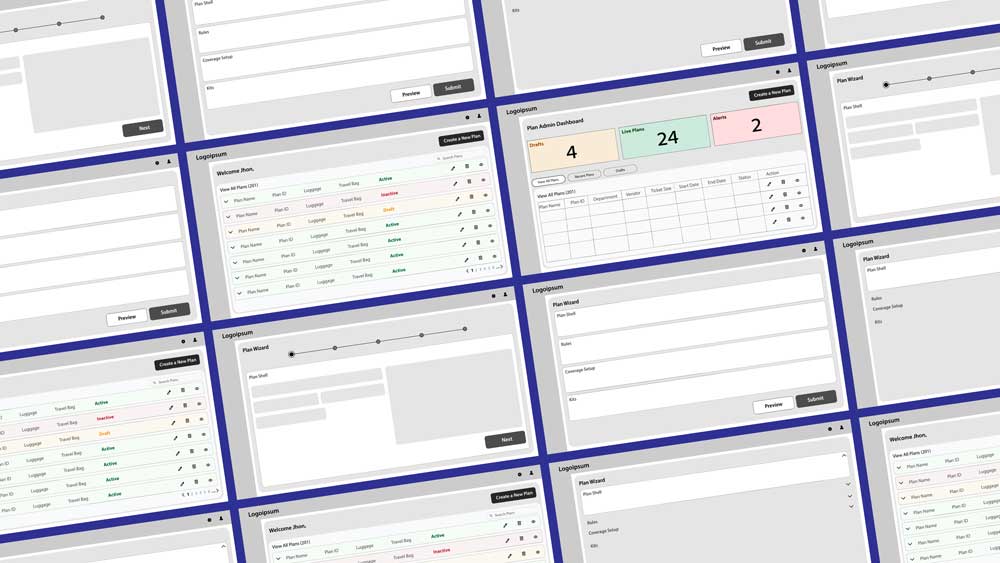
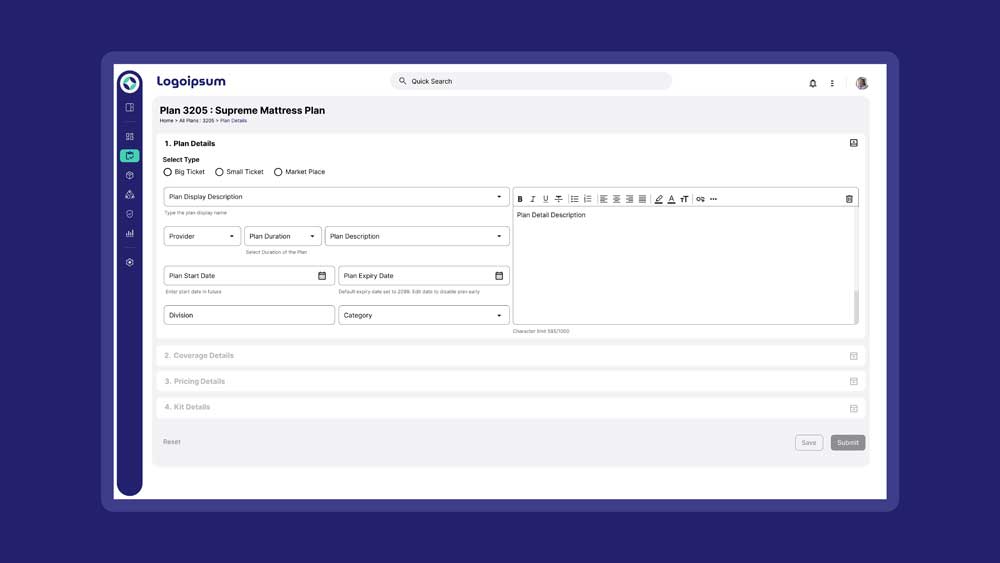
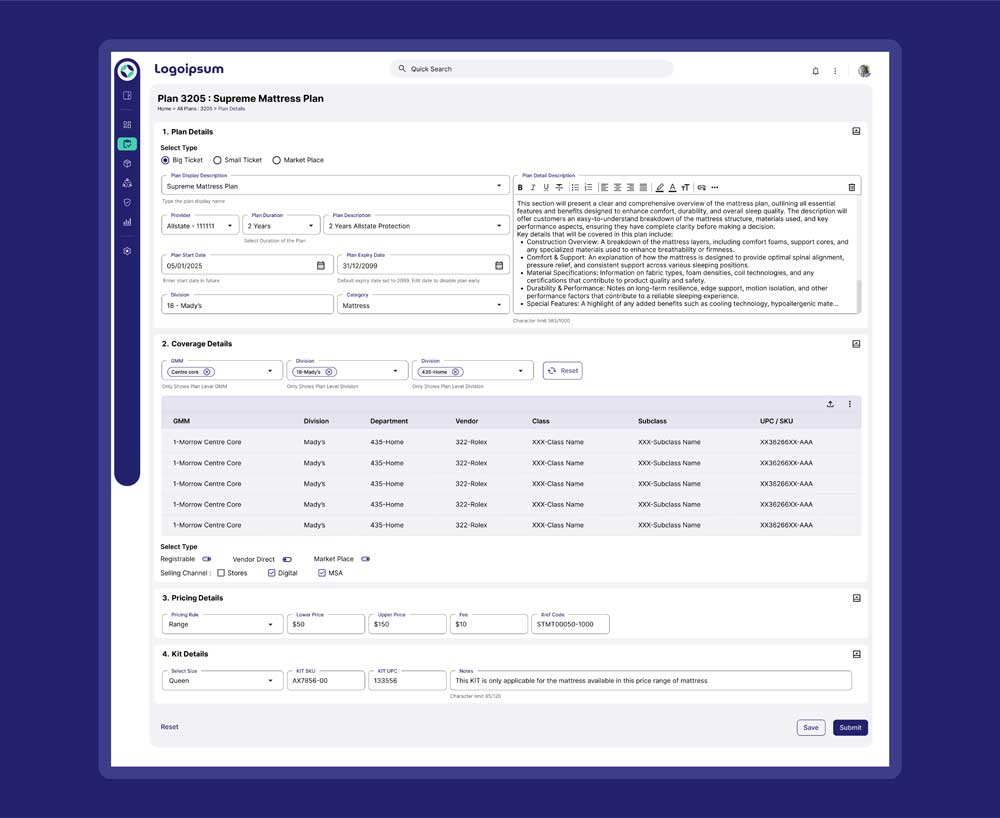
A guided step-by-step flow enabling non-technical teams to create and modify warranty plans independently.

Structured Lifecycle Visibility

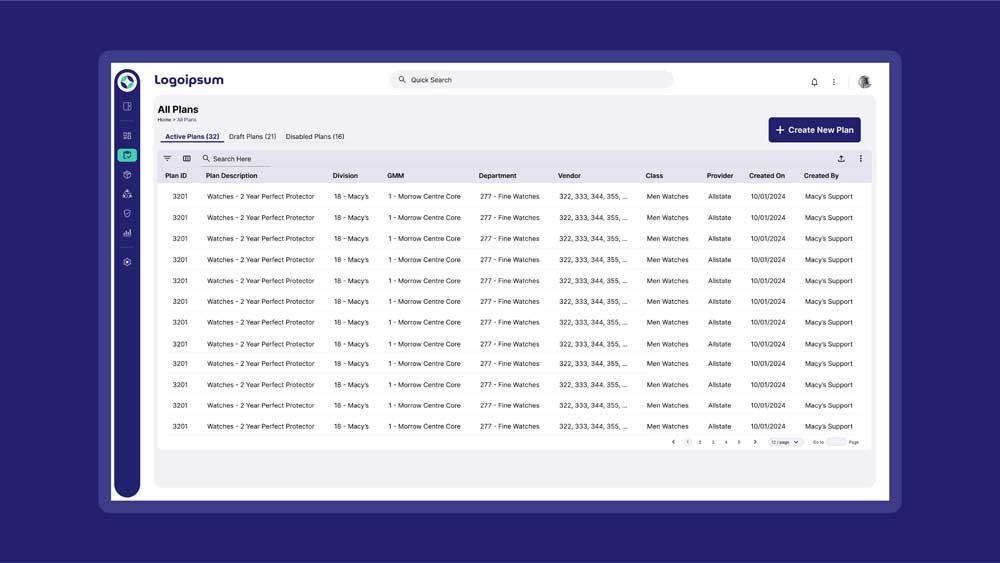
Clear stages for creation, activation, updates, and sunset—allowing teams to track even millions of plans with complete transparency.

Coverage & Eligibility Configuration

Streamlined interfaces to define pricing, duration, rules, and exclusions with fewer errors and simplified decision points.

Scenario-Ready Workflow

Built-in support for complex cases like mass updates, exception overrides, and plan deprecations.

Modular Information Architecture

A scalable IA that adapts to new product categories, future business models, and evolving internal workflows.

Design-System Aligned UI

Consistent, accessible components leveraging the existing design system for faster delivery and reduced cognitive load.

Backend-Conscious Interaction Models

Flows designed around technical constraints for seamless integration with existing backend processes.

Data-Safe Configuration Patterns

Validation-heavy inputs and confirmation steps to prevent errors that could impact thousands of customer purchases.

IMPACT MADE

These solutions delivered measurable improvements for the business:

Increased Team Autonomy

Business users can now create and manage plans without relying on engineering for every change.

Faster Go-to-Market

Reduced plan creation and modification time, enabling quicker rollout of warranty offerings.

Streamlined Operations

A unified workflow eliminated ambiguity, reduced rework, and improved cross-team coordination.

Lower Learning Curve

The guided, step-by-step builder allows even first-time users to complete tasks confidently with minimal onboarding.

Higher Accuracy & Fewer Errors

Built-in validations reduced mistakes in pricing, coverage rules, and eligibility configuration.

Greater Scalability

The platform can support millions of active plans, new product categories, and expanding warranty use cases.

Clear Lifecycle Tracking

Teams now have full visibility into each stage of a plan’s journey, improving audits and operational clarity.

Enhanced UX Influence

Your work elevated UX maturity — shifting the client from engineering-driven workflows to structured, user-centered processes.